编译原理
Lec1: Introduction
编译原理课程的第一章,介绍了编译器的基本概念、模块化设计以及常用工具。编译器是将一种语言转换为另一种语言的程序,分为多个阶段,每个阶段处理不同的抽象表示形式。课程还介绍了正则表达式和上下文无关文法,以及相应的工具Lex和Yacc,用于词法分析和语法分析。

编译器
- 什么是编译器:编译器实际上就是一个可以将一个语言(source language)转化成另一个语言(target language)的程序(equivalent program)。

Modules and Interfaces: Overview
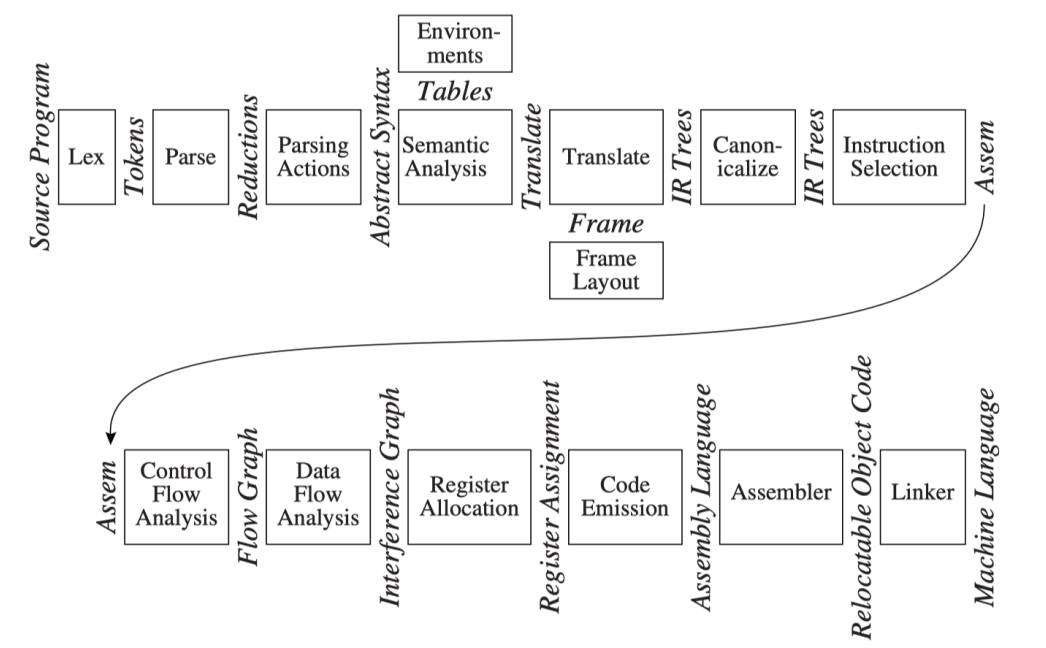
- 两个重要概念:
- Phases:one or more modules operating on the different abstract “languages” during compiling process
- 每一个阶段中,处理一种表示形式,输出另一种表示形式,相当于在不同“语言层次”之间转换。
- Interfaces:Describe the information exchanged between modules of the compiler
- 编译器各个阶段之间传递的信息格式
- 上一个阶段的输出,必须符合下一个阶段的输入格式
- Phases:one or more modules operating on the different abstract “languages” during compiling process
Phases
Phase 指的是编译过程中的一个“工作步骤”,比如如下所示:
| Phase | Description |
|---|---|
| Lex | Break source file into tokens |
| Parse | Analyze the phrase structure of the program |
| Parsing Actions | Build abstract syntax tree (AST) for each phrase |
| Semantic Analysis | Determine meaning; check types; resolve variable bindings |
| Frame Layout | Organize variables and parameters into stack frames |
| Translate | Produce intermediate representation (IR trees) |
| Canonicalize | Simplify IR; hoist side effects; clean conditionals |
| Instruction Selection | Map IR nodes to target machine instructions |
| Control Flow Analysis | Build control flow graph (CFG) |
| Dataflow Analysis | Analyze flow of values (e.g., liveness analysis) |
| Register Allocation | Assign variables to machine registers |
| Code Emission | Generate final assembly code |
Modularization
- Several modules maybe combined into one phase
- 有些模块会被整合在一个阶段中
- Simple compilers may omit the Control Flow Analysis, Data Flow Analysis, and Register Allocation phases
- 简单的编译器会省略 CFA、DFA、RA 这些优化阶段
Interfaces
Interfaces 指的是 phases 之间如何交换数据。比如 Phase 拿到 token:
Token getNextToken();Tools and Software
有两种非常有用的概念供我们使用:
- Regular expression: for lexical analysis
- Context-free grammers: for parsing
相应的,有两个工具供使用,来进行编译:
- Lex converts a declarative specification into a lexical analysis program
- Yacc converts a grammar into a parsing program

Written by
ZZC
每天研究怎么摸鱼的神人
Comments
评论功能即将上线